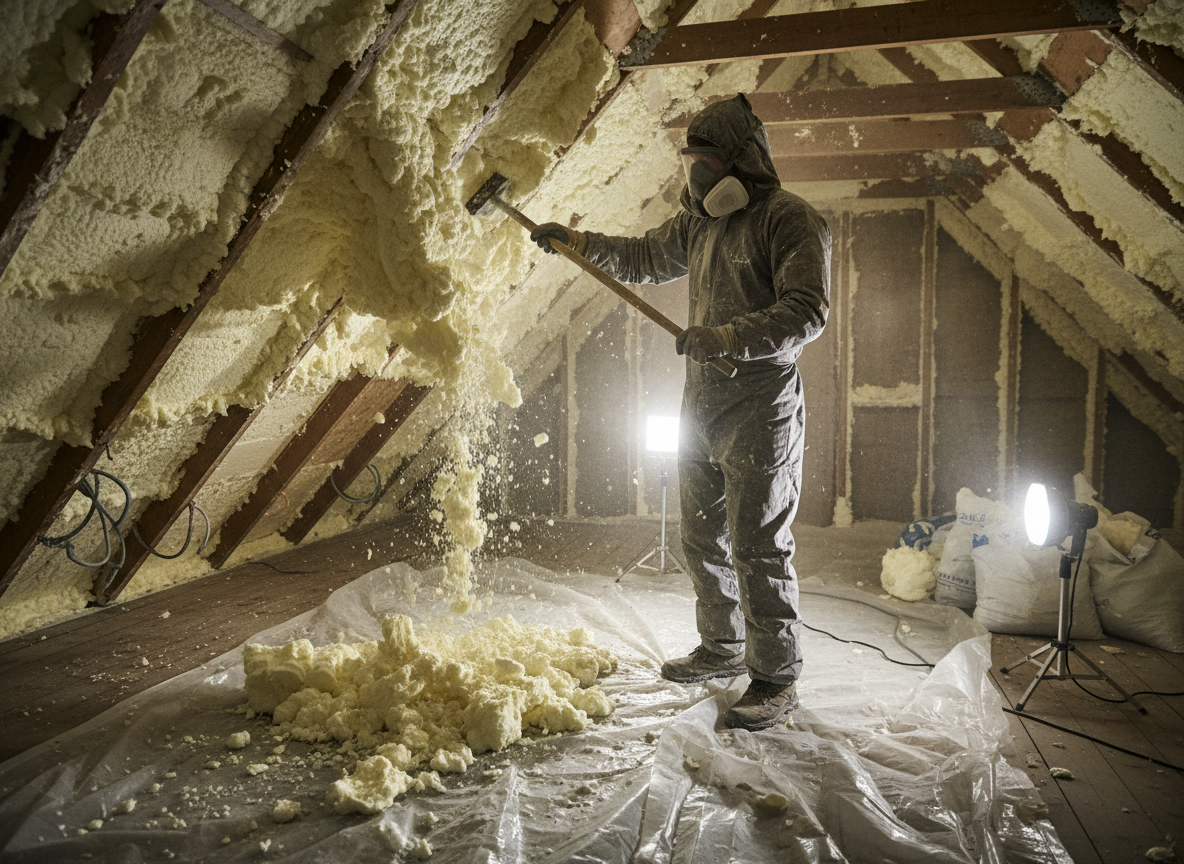
Telford’s housing stock includes many 1960s and 1970s properties where spray foam was applied directly to roof undersides in lofts. Once moisture becomes trapped against the original timbers, the foam starts to degrade and can lead to rot that spreads along rafters. Removal work here often requires careful cutting around electrical cables and pipework that run through the foam layer, especially in terraced homes around Dawley and Madeley where access is restricted.
Shropshire’s frequent rainfall and high humidity mean that any remaining foam residue must be fully cleared before new insulation or ventilation is installed. Incomplete extraction leaves behind small pockets that continue to hold damp against the ceiling plaster, creating recurring black mould spots on the rooms below. In properties near the Ironbridge Gorge, steeper roof pitches add extra time because debris has to be bagged and lowered by hand rather than simply swept into a chute.
Local building control in Telford now expects proof that the roof void has been properly ventilated after foam removal. Crews therefore install additional ridge and eaves vents on the same visit to avoid follow-up visits once the new insulation goes in. Older semi-detached houses in Hollinswood frequently have shared party walls, so containment sheeting must run the full length of the loft to stop dust migrating into the neighbouring property.
Disposal of the removed foam has to follow Shropshire waste rules; mixed loads containing timber or plasterboard cannot go into standard skips. PrimeStrip Services separates the foam on site so each material stream can be taken to the correct licensed facility without delays.
Technician insight
In Telford, the thing that catches most people out with Spray Foam Removal near me is the 1970s timber roofs around Dawley where the foam was sprayed right up to the eaves without any ventilation gap. Once you start cutting, you find the rafters have already started to soften because Shropshire rain has been sitting against the foam for years.
Hollinswood Loft Extraction
Homeowner noticed black mould on bedroom ceilings after heavy winter rain. Inspection showed closed-cell foam had bridged the eaves on a 1972 semi-detached house. We cut the foam back in sections, cleaned the rafters, added ridge vents, and cleared all debris the same day so new mineral wool could be laid without delay.
How it works
- 1
Initial Loft Inspection
Assess foam depth, timber condition and access routes through the property in Telford.
- 2
Containment Setup
Seal stairwells and party walls with sheeting to keep dust inside the loft space.
- 3
Mechanical Removal
Cut and bag the foam in sections, working around cables and pipework without damaging the roof structure.
- 4
Final Clearance and Ventilation
Vacuum residue, install additional vents where needed, and remove all waste from site.
Pricing
Cost depends on loft size, foam thickness and access difficulty; quotes provided after inspection.