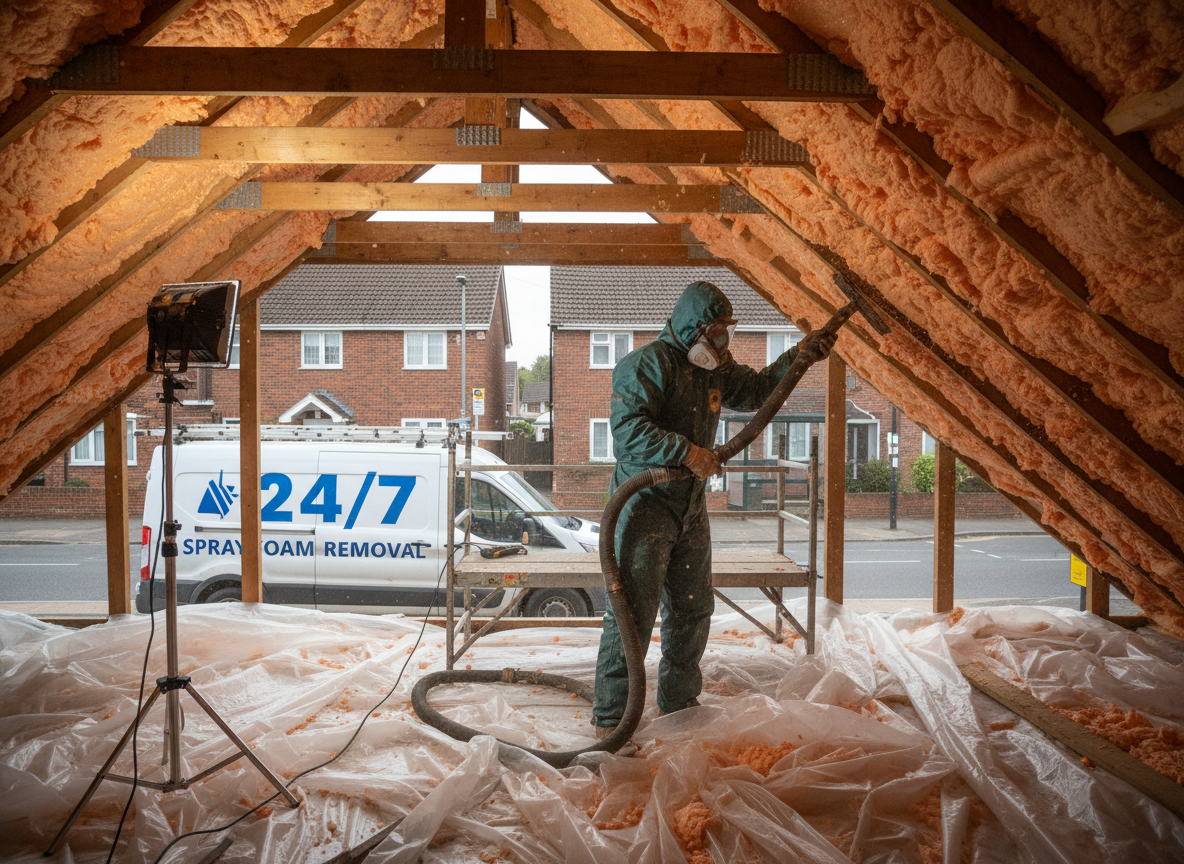
Telford's post-war housing stock, particularly estates around Dawley, Madeley and Oakengates, often contains closed-cell spray foam installed in the 1990s and early 2000s that has now begun to degrade. Once winter temperatures drop and lofts stay cold, moisture trapped against the rafters leads to timber staining and reduced ventilation. Removing the foam requires careful mechanical scraping and vacuum extraction without damaging the original felt or timbers, especially on older terraced properties where access is limited.
Shropshire's frequent rainfall means any residual foam dust left in the loft can quickly turn into a mould risk once the insulation is gone. We bag and remove all material the same day to prevent it settling into the rooms below, a common complaint on jobs in the TF3 and TF4 postcodes. Homeowners in these areas frequently discover the foam was applied directly over existing mineral wool, creating an extra layer that must be separated before disposal.
Edge cases we see regularly include foam that has expanded through gaps into the eaves or around chimney stacks on semi-detached homes in Wellington. These sections must be cut free rather than pulled, otherwise the rafter ends can be damaged. We always check for asbestos-containing soffits before starting, a precaution required on many 1960s-1970s Telford properties.
Seasonal Considerations
Winter jobs in Telford require temporary loft boarding and dust containment because cold air draws fine particles downward into living spaces. Summer work allows better natural ventilation but increases the chance of foam softening and sticking to tools.
Technician insight
In Telford the thing that catches most people out with 24/7 spray foam removal is the amount of foam that has crept into the eaves on 1970s semis around Dawley. Once you start pulling, you find it has bonded to the felt and you have to cut it free carefully or you tear the underlay, especially after a wet winter when the timber is still holding moisture.
Loft foam removal after water staining reported
Homeowner in Madeley contacted us after noticing ceiling marks following heavy rain. We found 150 mm closed-cell foam trapping moisture against the rafters. We removed the foam in sections, cleared the dust and left the loft ventilated; the staining dried out over the following weeks with no further leaks.
How it works
- 1
Site Assessment
We attend the property in Telford or nearby Shropshire villages to inspect loft access, foam depth and any timber condition issues.
- 2
Containment Setup
Dust sheets and negative-pressure extraction are placed to protect the rest of the home during removal.
- 3
Foam Extraction
Mechanical scraping and industrial vacuuming remove the foam in sections, with special attention to eaves and around penetrations.
- 4
Clearance and Disposal
All material is bagged on site and taken away for licensed disposal, followed by a final loft clean.
Pricing
Cost depends on loft size, foam thickness and access difficulty; we provide an upfront quote after inspection.