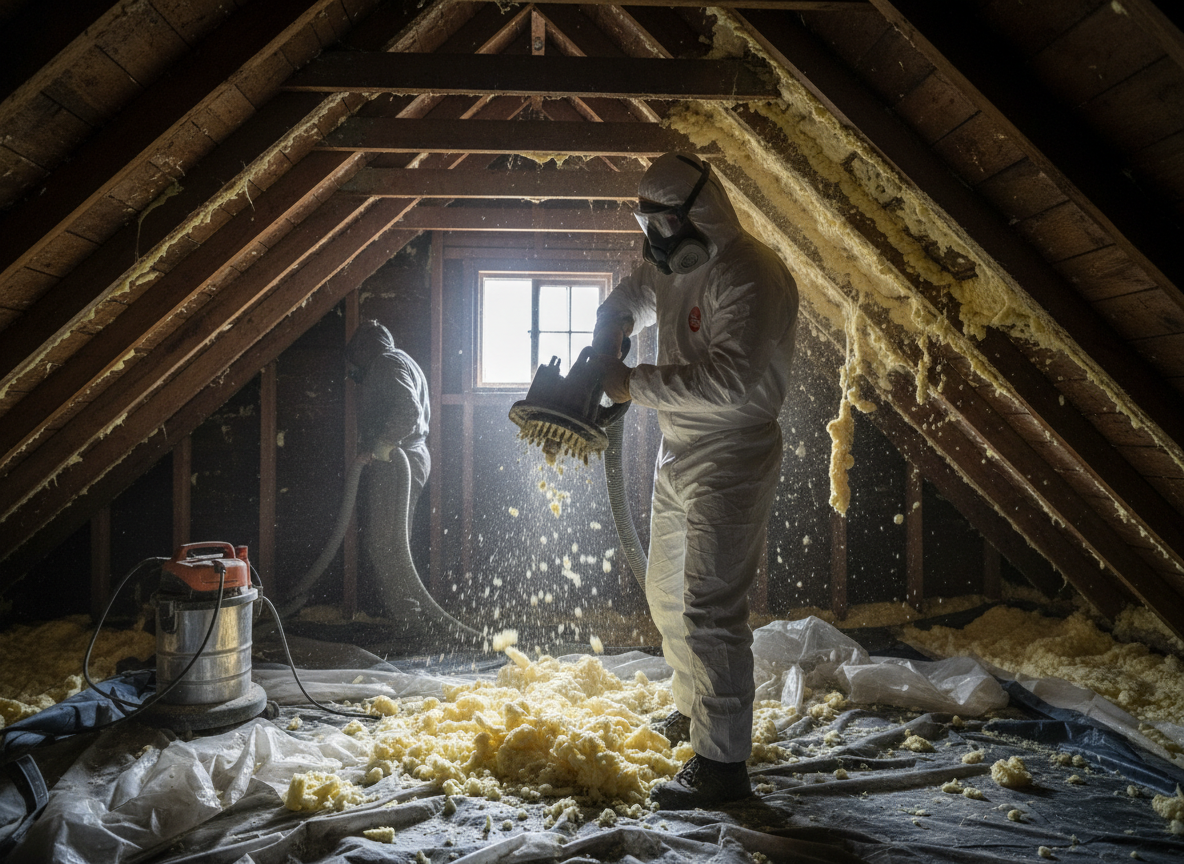
Telford's post-war housing stock, particularly 1960s and 1970s semis and terraces in areas like Hollinswood, Dawley and Madeley, often received spray foam in lofts during the 2000s energy grants. Once winter temperatures drop and condensation builds under the foam, the closed-cell material prevents the roof from breathing, leading to wet rot in rafters and felt. Removal requires careful mechanical stripping followed by timber treatment rather than simple scraping, because any residue left behind will continue to hold moisture against the wood.
Shropshire weather brings frequent driving rain and high humidity, especially on exposed ridges around the Wrekin. Homeowners in these spots notice sagging ceilings or musty smells first. We cut the foam into sections using oscillating tools to avoid tearing the underlying membrane, then vacuum the dust that would otherwise settle into insulation below. Edge cases include foam that has been applied over older mineral wool, where the two materials bond and pull the original insulation loose during removal.
Local building control in Telford now requires ventilation upgrades after foam removal on many pre-1980 roofs. We always check for existing soffit and ridge vents before starting and note any that need clearing or adding. The work is dusty and requires full containment sheeting to protect the rooms below, particularly in two-storey homes where debris can travel down stairwells.
Technician insight
In Telford, the thing that catches most people out with spray foam insulation removal is how quickly the 1970s rafters in estates like Sutton Hill start to soften once the foam is taken off. The foam has been holding the damp in for years, so you often find the first 50 mm of timber needs cutting back rather than just brushing.
Hollinswood Loft Foam Removal
Homeowner in Hollinswood reported musty smell and ceiling staining after heavy autumn rain. We found 120 mm closed-cell foam bonded to saturated felt and early wet rot on three rafters. The foam was sectioned out, timbers treated, and existing ridge vent cleared to restore airflow.
How it works
- 1
Site Assessment
We inspect the loft space from St James House jobs in Telford, checking timber condition, foam depth and any signs of water ingress before quoting.
- 2
Containment Setup
Plastic sheeting and negative air are installed to keep dust out of living areas in the property.
- 3
Foam Removal
Foam is cut and lifted in sections using oscillating blades to protect roof felt and rafters.
- 4
Timber Treatment and Clean
Exposed timbers are treated where needed and all residue is removed before final inspection.
- 5
Ventilation Check
We confirm existing vents are clear and advise on any additional airflow required for the roof.
Pricing
Pricing depends on loft size, foam thickness and access; we provide upfront quotes after inspection.