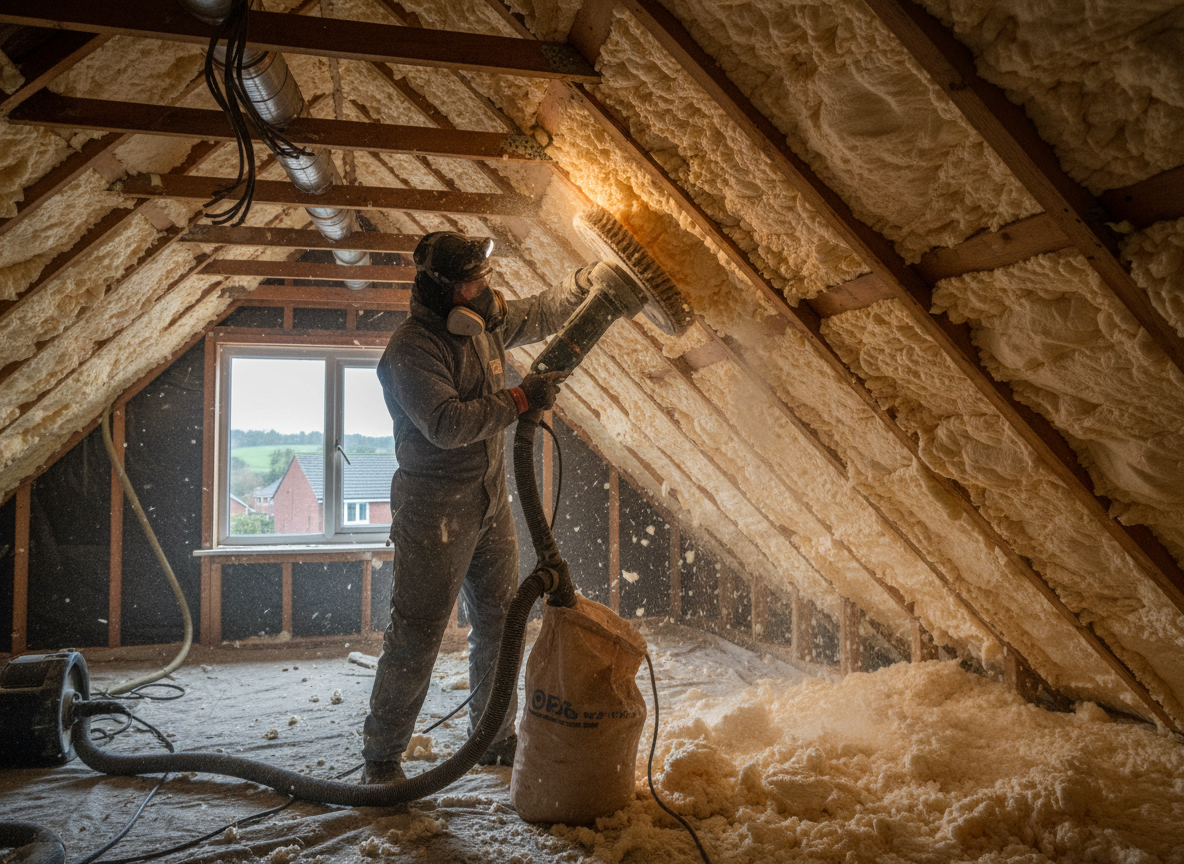
Open cell spray foam was widely installed in Telford's 1960s and 1970s new-town homes to improve loft insulation, but it often traps moisture against timber joists when Shropshire's frequent rain and mild winters raise humidity levels. Removal requires cutting the foam back in controlled sections so that the underlying roof structure and electrical cables can be inspected for rot or corrosion before any new insulation is considered. In properties around Hollinswood and Ketley, the foam frequently adheres directly to the original plasterboard ceilings, which means extra care is needed to avoid pulling down sections of the ceiling during extraction.
The process starts with negative-air containment to stop foam dust migrating into living spaces below. Technicians then use oscillating blades and hand tools to separate the foam from rafters without damaging the felt or battens, a step that is especially important in older Telford semis where roof timbers are already showing signs of age. Once the bulk is removed, residual material is vacuumed from every crevice because even small pockets left behind can re-expand if moisture returns. Homeowners in the TF2 and TF3 postcodes often discover that the foam has also crept into party walls, requiring access from both sides to achieve a clean finish.
After extraction, the roof void is left ready for inspection. Any affected timber is marked for the owner's builder to treat, and ventilation is checked to prevent future condensation problems common in Shropshire's damp climate. This staged approach keeps disruption to a minimum while ensuring the property meets current building standards for a dry, ventilated loft space.
Technician insight
In Telford, the thing that catches most people out with open cell spray foam removal is how the foam has bonded to the original 1970s timber in lofts around Hollinswood and Old Park; once winter damp sets in, it pulls the felt off the battens if you try to rip it out in one go.
Loft foam removal in a 1970s Telford semi
Homeowner noticed musty smell and sagging ceiling in a Hollinswood property. We found open cell foam fully adhered to joists and felt with moisture trapped underneath. Sections were cut away carefully, dust contained, and the void left clean for the owner's builder to treat the timber.
How it works
- 1
Site Assessment
Inspect the loft or cavity, identify foam depth and any hidden services, and confirm access points in the Telford property.
- 2
Containment Setup
Install negative-air machines and floor protection to contain dust before cutting begins.
- 3
Foam Extraction
Cut and remove open cell foam in sections, taking care around joists, cables and felt in local post-war roofs.
- 4
Final Clean and Handover
Vacuum residues, check ventilation paths and leave the space ready for the owner's next steps.
Pricing
Cost depends on property size, foam thickness and access difficulty; we provide an upfront quote after the initial assessment.