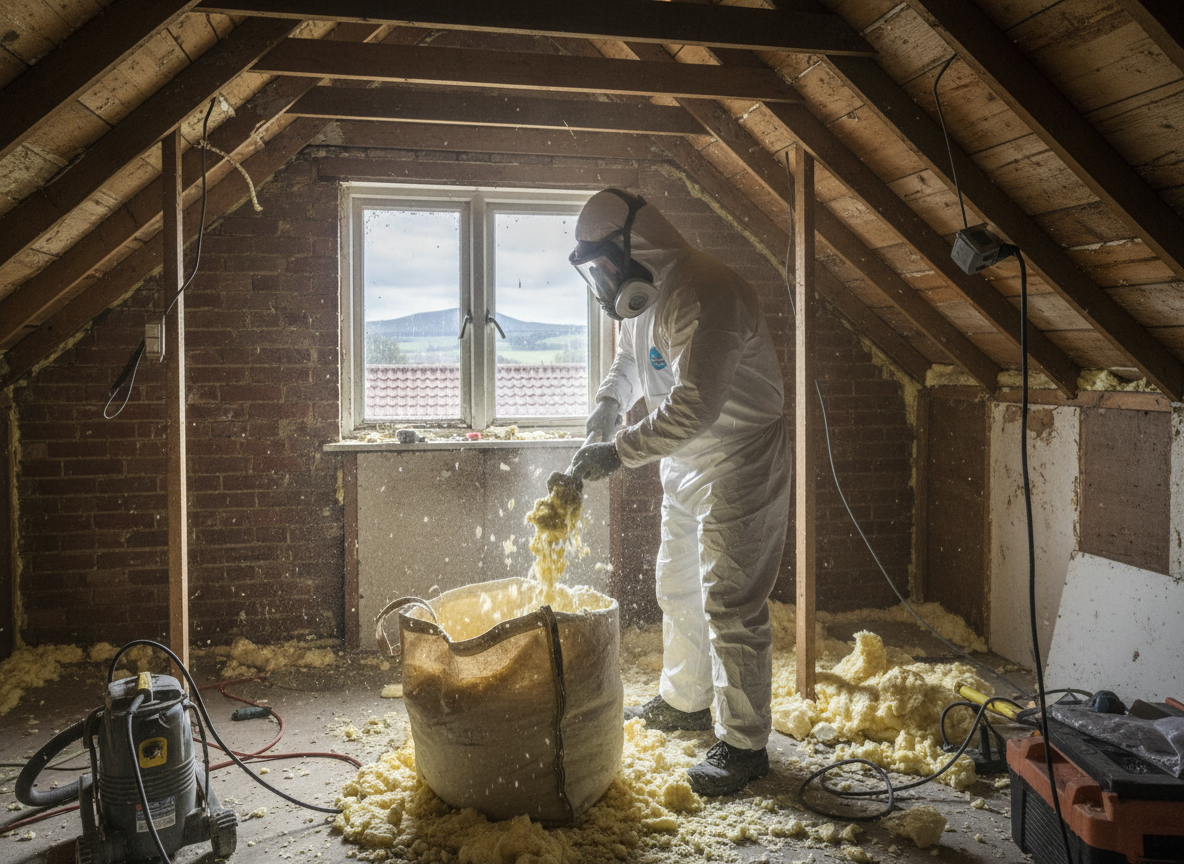
Telford's post-war housing stock around Hollinswood, Ketley and Madeley often features pitched roofs with closed-cell spray foam applied directly to rafters in the 2000s and 2010s. Mortgage lenders now flag these installations because they trap moisture against timber, mask leaks and block the ventilation paths required by current building standards. Removal crews must work from the loft side, cutting and scraping the foam without damaging felt or battens, then clearing residual adhesive that can hold damp for years in Shropshire's frequent rain.
Edge cases appear regularly on terraced and semi-detached homes near the A442 where limited headroom and shared party walls complicate access. Foam sometimes extends into eaves or over electrical cables, requiring careful isolation before cutting. Once stripped, the roof must be left fully ventilated; any remaining closed pockets can trigger fresh lender rejections. Disposal follows Environment Agency rules for construction waste, with loads taken to the local transfer station rather than mixed with household refuse.
Homeowners in Telford frequently discover the issue only after a surveyor’s report flags the foam during a mortgage application. Early inspection from the access hatch reveals whether the foam is open or closed cell and whether it has caused timber staining. Prompt removal before the lender deadline avoids chain delays, especially in winter when shorter daylight hours limit safe working time in unlit lofts.
Technician insight
In Telford, the thing that catches most people out with mortgage lender spray foam removal is the way foam in 1970s-1980s semis around Hollinswood often hides failed felt laps; once stripped you find water tracking straight onto the ceiling, turning a one-day job into a repair that must be fixed before the lender will proceed.
Ketley Loft Clearance for Mortgage
A Ketley semi had closed-cell foam covering the entire roof plane. The lender survey rejected the application. We stripped the foam, found stained rafters from a slipped tile, cleared residue and restored airflow. The follow-up inspection passed and the mortgage completed without further delay.
How it works
- 1
Initial Loft Inspection
Access the loft from Telford properties to assess foam type, coverage and any hidden damp or electrical issues.
- 2
Safe Foam Removal
Cut and scrape closed-cell foam from rafters and felt, isolating cables and protecting insulation below.
- 3
Clearance and Ventilation Check
Remove all residue and confirm roof ventilation meets mortgage lender standards before sign-off.
- 4
Waste Disposal
Bag and transport waste to approved Shropshire facilities with full documentation for the lender.
Pricing
Upfront quote after inspection; cost driven by loft size, foam thickness and access difficulty.